Make 90s gamers’ Christmas dreams come true with a G’AIM’E Time Crisis lightgun for modern TVs
The G‘AIM’E brings back the long-lost art of the lightgun shooter, while celebrating 30 years of Time Crisis


AI may be the buzz-word bingo term of the year but, for once, we’re able to embrace it without reservation — thanks to artificial intelligence, I’m getting to recreate the greatest Christmas of all time: Christmas 1997.
Why? How?
First the “why” — Christmas 1997 was the year I got a PlayStation 1, and with it the home port of arcade lightgun classic, Time Crisis. Many a pound coin was saved as I blasted away baddies at home rather than with the coin-op arcade machine. Santa did me proud, and it was the start of a beautiful friendship between me and my PS1.

And the” how”? That’s because, thanks to the nifty new G’AIM’E hardware and some AI wizardry, we’re finally able to get a faff-free lightgun experience at home on modern flatscreen TVs. And it’s brilliant.
Want to make a retro gamer’s Christmas dreams come true? The G’AIM’E might just be the answer. Read on to find out why.
G’AIM’E Lightgun: In short…
- AI powered lightguns that bring arcade shooters to your living room
- Easy to set up
- Works with TVs and projectors
- Comes pre-loaded with classic games
- Available now, starting at £99 for a single gun, console and Time Crisis
- ‘Premium’ bundle costs £149.99 and throws in three additional games and an arcade-authentic foot pedal
- ‘Ultimate’ bundle costs £199.99, includes two guns plus the pedal, all the games, and throws in bonus physical collectibles

An AI-fuelled arcade revival
Gamers of a certain vintage will have fond memories of the many lightgun games you could find in your local arcade. These point-and-shooters, with accessory guns that you pointed at a screen to aim and fire, were big business in the arcade’s hey-dey, and in the era of the bulky CRT TV screen, they were a core part of the at-home gaming experience, too.
But flat screen TVs changed all that. The aim tracking methods changed with the TV technology, old accessories no longer worked, and motion tracked consoles like the Nintendo Wii could never really match the experience of dedicated lightgun shooters. Plus, the decline of the arcade meant the lightgun shooter as a gaming genre fell out of vogue, and fewer games were available to be ported for home play.
It’s no wonder then that the G’AIM’E lightgun, created by Tassei Denki, cooked up a crowd-funding storm when it was revealed on Kickstarter. It managed to raise more than £860,000 by promising a dedicated console with AI-trained lightguns that would accurately work on all manner of TVs, including projection screens. Gamers starved of the arcade-at-home experience lined up to pledge their cash.
And, despite some small gripes, it was money well spent.
The hardware and set-up
To be clear, modern lightguns do exist, but they’re quite notoriously convoluted to set up, and are predominately for enthusiasts willing to work with emulators and PC software to get them up and running, making the plug-in-and-play nature of the G’AIM’E very appealing.
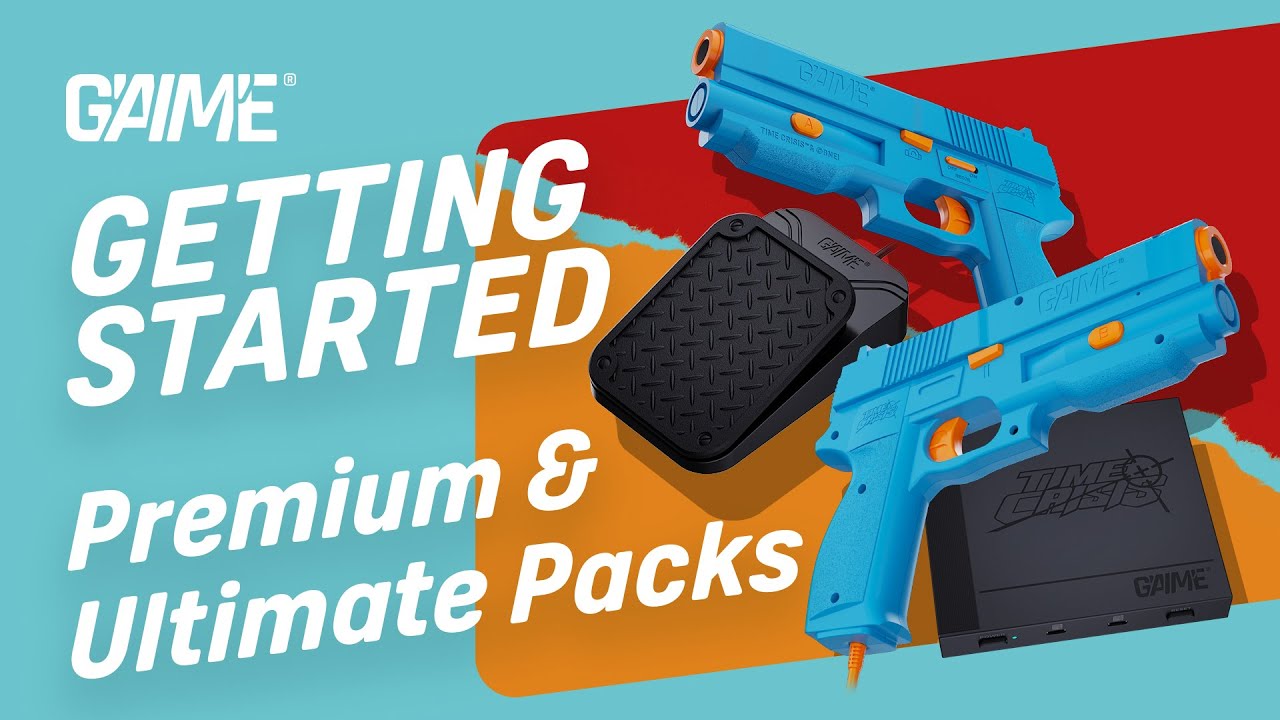
The fact the hardware on offer here is so satisfying and easy to use is just the icing on the cake. The G’AIM’E package consists of a main console unit (seemingly running a fork of Android) that plugs into your TV, plus the USB-C cabled gun. No wireless shooters here.

There’s two USB-C ports on the front of the console (a small black box the size of two CD cases stacked on top of each other), allowing for a second gun to be added for multiplayer play, or a pedal for arcade-accurate ducking and reloading in supported games. Those added extras are included in the pricier Premium and Ultimate bundles — you get just the console, a single gun and a single game at the basic tier.
Set up is surprisingly simple. Plug the power supply in, hook up the HDMI cable to your TV or projector (yes, projection screens work here!) and the console fires up into its calibration mode. You’ll be tasked with shooting a number of onscreen markers a few times, and then boom! You’re in the game selection menu.

A few pointers are shared to make sure calibration is as accurate as possible. You’ll need a distance of about 3 metres between you and the TV for a 50-inch TV, and 3.5m to 4m+ for 65-inch TVs and larger. Try to play in a darker room if possible, or at least minimise lights near your TV — lamps, other screens, or windows should be switched off or covered up, as it can confuse the camera tracker built into each gun. Also, make sure you’re using a high-quality USB-C charger — I started off using one I had laying around, and the guns kept disconnecting as a result. Only the Ultimate bundle includes a charger in the box.

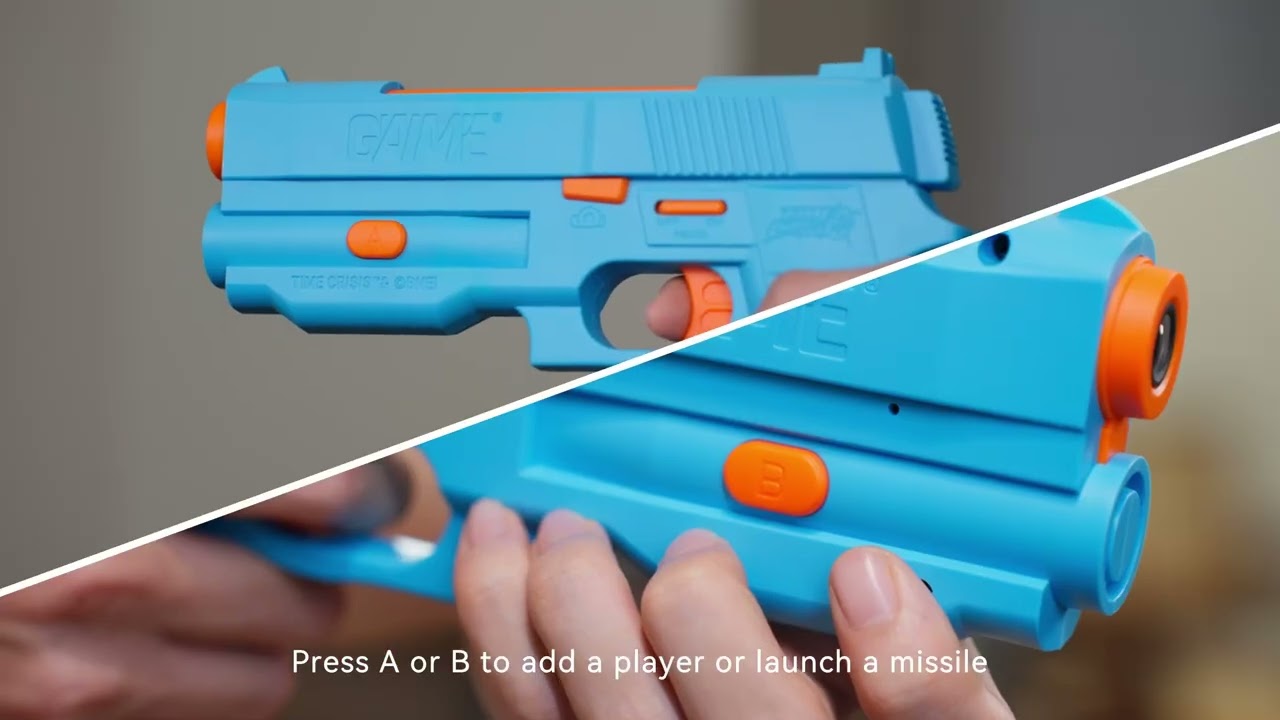
Those boxes ticked, it’s a joy to play. Accuracy is as good as I remember from the PS1 days, and the blue-with-orange-highlights guns themselves are chunky and sturdy, walking that line between toy and not-quite-a-firearm satisfyingly. The force-feedback accompanying shots is a little weaker than you’d get in an arcade, but that’s a minor point, and the option for playing with a pedal will bring back fond memories of the original experience, very well recreated here. Rubber pads on the bottom keep it from sliding around too much underfoot.
The games
The star of the show here is undoubtedly Time Crisis, bundled in at every tier of the G’AIM’E package. Its innovative-for-the-era cover mechanic remains as satisfying as ever, and its against-the-clock shootouts against polygonal baddies as tense and thrilling as remembered.

A new conversion from original developers Namco Bandai is included here, based on the arcade original, meaning it's as close to that initial experience as you’re likely to find these days outside of a retro arcade. Note it is based on the arcade version — not the PS1 version which included a secondary campaign to fire through, meaning you might see all it has to offer relatively quickly.
Stump the cash for the Premium and Ultimate bundles, and you get three additional games — Point Blank, Steel Gunner, and its sequel Steel Gunner 2.

Of all the games offered, Point Blank may be the secret best of the bunch, certainly in terms of replayability. Offering a two-player mode that Time Crisis lacks, it’s a madcap point-chasing shooting gallery, full of minigames and manic ideas. You’ll likely spend most of your time here.
Steel Gunner and its sequel are 2D sci-fi shooters, and the oldest games included on the console. They’re still good fun, but show their age more than Time Crisis and Point Blank.
Notes for next time
We’ve had a lot of fun playing with the G’AIM’E kit, but there’s a few gripes we hope will be ironed out should any next-gen model appear, or variants of the hardware be produced.
Though accurate, the calibration can be a bit picky about the environment the kit is best played in. The ‘AI’ here has been baked in during development to work with as many TVs as possible, but doesn’t account for individual setups — this isn’t an actively learning model that can adapt to the unique characteristics of your living room. Likewise, it’s not saving any information about your setup, meaning you’re going to have to go through the calibration process every time you fire it up.
Secondly, and perhaps more importantly, there’s no plans to offer further games down the line. There’s no Wi-Fi onboard, and though the developers say the USB-C ports can be used to issue firmware updates in the future, the business model as it stands today is to sell the guns alongside preloaded consoles. So if any more games become available via the G’AIM’E, at present you’d have to buy the kit all over again to play them. Hopefully the manufacturers see sense and offer downloadable gaming updates, or at the very least offer future console units as sold-separately options without the guns.

Final verdict
Those small concerns aside, the G’AIM’E lightgun is a metaphoric and literal blast. Using the best of today’s technology to hark back to a golden age of gaming’s past, this is retro revivalism at its best. Well considered, well made, and with a bunch of classic games to play through, it’s time to party like it's 1997 all over again.

Skip the search — follow Shortlist on Google News to get our best lists, news, features and reviews at the top of your feeds!
