Ish: This indie film shows Luton’s soulful young mandem in a new light
Imran Perretta’s debut Ish is a gorgeous story of a friendship between two young boys. We talk to the director and the film’s street-cast stars, Farhan Hasnat and Yahya Kitana.


If there’s anything as embarrassing as being a teen, it might be seeing yourself acting on screen.
For Yahya Kitana, who was cast three years ago in Ish, his first film, aged 12, one day that sticks in his mind was shooting a pivotal scene in which his character Maram is alone on the street.
“They mugged me so bad,” he says, shaking his head, “the angle they got me was just nuts.”
We’re chatting on Zoom and at this point producer Dhiraj Mahey jumps in with “what happened after the cameras turned off? Everyone clapped you.” His co-star Farhan Hasnat, who plays the titular Ish and is just two years older, now 17, remembers it differently too: “He’s saying that but I was sitting next to Imran as he was doing that particular scene. Everyone was in tears at Yahya. Imran was crying, everyone on set, tears were falling down.. and as I was watching him act, I was like, this kid’s sick, he’s got talent.”
Imran is Imran Perretta, a visual artist, composer and now feature film director - Ish is his debut. And while he’s now in his 30s with a wife and two kids of his own, this coming-of-age story set in Luton pulls from his own upbringing in Streatham, South London — specifically how children like him were seen by themselves and their communities versus how they were seen by the state.
We talked in an air-conditioned green room at BFI Southbank during a sweltering London heatwave at the start of July. Perretta, cool and calm throughout, explained how he wanted to look at how young men from marginalised backgrounds are “so often framed as adults.”
(Note: Discussions about plot, character and themes ahead, so read on after you’ve seen the film if you want to keep it 100% spoiler-free).
The film follows 12 year-old boys Ish and Maram as they mill about, make a den in the forest, button bash at fighting games and smash berries for pretend fist-fights one long summer.

“When you spend enough time with those boys, you see the love and care and affection they have for each other and the playfulness,” he says. “And, of course, some of that can be a little bit edgy or it can be physical but it comes from a place of love. Their play is treated as dangerous and a moral aspect is pushed onto it.”
Is he talking about the characters or the actors? Not enough has changed since Perretta was that age for that question to matter all that much. The pair of first-time actors got the parts after Perretta and casting director Lara Manwaring auditioned 900 local schoolboys in Luton - Farhan jokes that when it got down to the last four, he told Yahya to “be as shit as you can” with the others. The director has credited Farhan with ‘co-creating’ the central character of Ish and a lot of the relationship-setting between the two boys was captured as naturally as possible. In real life, their families have been friends since they were “in nappies”.

Director Imran Perretta
“Imran was like an older brother on set, he was like our safety net, we’d be like ‘yo, help us out’”, says Farhan.
“I would struggle mentally about not doing it right. Imran would be there like, ‘just have fun with it, be true to yourself’’. It was much the same for Yahya: “The way I performed was all ‘cos of Imran, from how he made me feel comfortable in that space.”
For such an elegant, assured film as Ish, one concerned with moods, feelings and images more than on-the-nose political debates, there’s a lot bubbling beneath the surface. When Perretta was around 13 years old, he was out with a friend and suddenly pulled into a police van for a stop-and-search. This was not long after 9/11, with all the over-reach by the state of the ‘hostile environment’, which followed for British Muslim, South Asian and Middle Eastern communities in the UK.

It’s hard not to feel the spirit of both Satyajit Ray’s classic Pather Panchali and the British social realism tradition, complementarily, within Ish. But narratively, Perretta is also threading a different, fine needle. A similar incident of police aggression to the van stop, followed by the subsequent impact on Ish and Maram’s friendship, works as an emotional hinge-point for the whole story, a la Jean-Luc Godard’s Le Mépris or Kelly Reichardt’s Certain Women. Both Ish and Maram have stuff going at home too: Maram’s father appears as a harsh disciplinarian and Ish’s mother has recently died. His wise, old Nanu, always-at-work father Naeem and warm, no-nonsense sister Samira (played sweetly by singer Joy Crookes in her acting debut) offer both relief and confusion to the young boy.
To do justice to these layered emotional stakes for the characters, with two street-cast child actors more than carrying the lead roles, marks Perretta out as a major new voice in British film-making.
Imran Perretta’s Luton
Perretta cleverly intersperses the film with unsettling surveillance footage from police vans — which would hound certain areas like Luton — with timestamps, radio noises, bleeps and blurred out or targeted faces on passersby. Its memorable opening shot is of a bicycle and a single trainer in the middle of the road, then suddenly, whoosh, black as the door slams shut: we’re inside the van. He says they didn’t crack the “visual language” of the van the first time round on the main shoot in 2024 so additional footage was shot later during pickups. “It just became really clear, once we’d done the majority of the edit, that we needed to establish the ‘bad guy’ so to speak, imply what the stakes are early without really understanding what it is we’ve looked at.”
Citing Lacan’s ‘mirror stage’ theory, which suggests how babies first come to recognise themselves and an ‘identity’ arises, Perretta has, as an adult, dug into what those police stops — the racial profiling happened multiple times — did to his psyche.

“It was a moment of coming to understand how the world saw me,” he says.
“There was some sort of ego death or existential reckoning there and I totally quietly, privately melted down about it. Because I was like ‘oh shit, outside my family home people see me as a threat and I’m not a threat.’ A formative brain just goes mental with that information. That moment politicised me and gave me an art practice.”
That classic coming-of-age ‘loss of innocence’ we so often see in cinema comes across beautifully in Farhan’s mournful eyes and Yahya’s defensive posture, with a shot of Ish’s feet not quite touching the bottom of a swimming pool making its scene full of peril.
“Don’t get me wrong, they wind each other up like no-one’s business,” Perretta notes, “but they both have this sort of worldliness to them that was just immediately obvious through the audition process. They’ve both seen a lot in their lives and you can feel that.” Perretta jokes that they’re both “a foot taller and a lot hairier” now than they were back at the start but they’ve taken this “incredibly bizarre life experience”, of playing versions of themselves to an extent on-screen, in their stride.

The alienating distance of the roaming van camera feeds are thrown into sharp relief by the way Perretta has chosen to shoot Luton: in luminous black-and-white. He was partly inspired by the work of documentary photographers like Tish Murtha and Chris Killip, whose monochrome work felt “timeless” compared to colour images.
“It made Luton feel monumental, the concrete felt like marble,” he says. “I take a lot of photographs when I’m researching a place, what you saw in colour was urban decay and that wasn’t what I wanted. I wanted to flatter the place.” The choice to “recast” Luton as a “classic, cinematic landscape” was also bound up with Ish and Maram’s point of view: “It’s not a small town to them, it’s a big town, that’s their manor.”
The counterpoint to all this is Perretta’s conception of a Luton pastoral, right on the edge of the M1 motorway: “There was this view that I became really obsessed with, through the hoardings where you come out of the forest. I love the idea that you come out and you’d just be hit with this main artery.” It’s a stunning shot in the film, almost the classic John-Wayne-in-the-open-doorway composition, only it’s Ish climbing through a gap in some fencing. For the director, Ish and Maram’s makeshift den in the forest is “where they could be the fullest version of themselves”, climbing trees and getting up to mischief sure and yet “where you can feel part of nature but also sheltered and enclosed”.
Making Magic
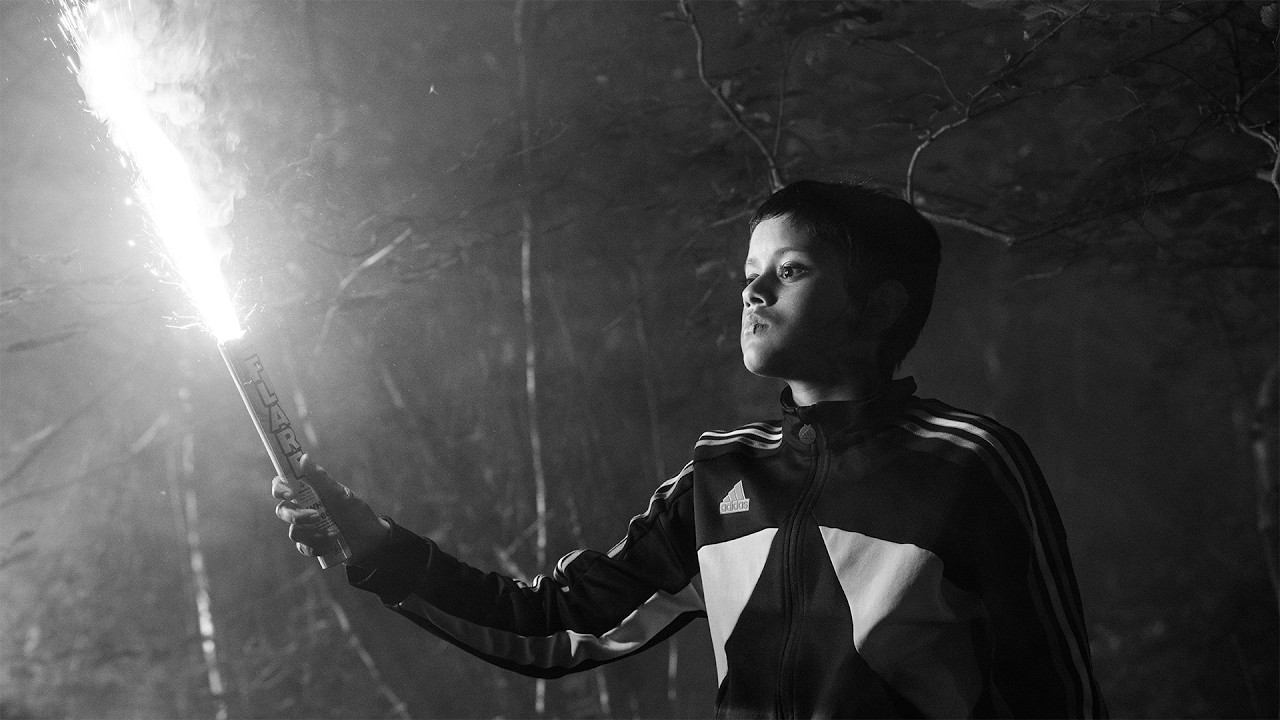
The crescendo to Perretta’s love letter to the forest comes with a sublime sequence that makes the monochrome film-making really sing. Ish, Maram and three other boys have got their hands on a bunch of fireworks (nicked from a shop) and they’re running through the trees, waving flares, setting them off and causing mayhem. When your actors are all under sixteen, you have to abide by strict working hours and this was a night shoot... on the last day.
“So we had seven minutes left with the boys,” Perretta says. “Jermaine, the DP, and I were just like ‘fuck it’ we’re just going to get them to run around and we’ll just follow ‘em, like you just do your thing.” Perretta shouts out Jermaine Canute Edwards, his director of photography who also shot Akinola Davies Jnr’s My Father’s Shadow last year: “In every way he’s a genius but his handheld I would say is particularly unique, the way that he moves with people, he does this incredible dance with the camera that I just find extraordinary.”

The team lit everything, all ready for the fireworks and then two minutes into their final seven minutes…
“All the generators conked out, so we were in complete blackness, all the monitors went. And we’re just following them in the pitch black, there was no additional lighting, just them running with the flares. To me, it’s one of the most magical parts of the film. Visually, and performance wise, it’s just so free and it feels so true. The film gods decided to pull the plug and they gave us the greatest gift.”
Hearing about the young actors’ complete ignorance of the technical glitch makes the whole night sound even more surreal. “All five of us were running around,” says Farhan, “and we just hear Imran in the background, talking to people like ‘generator’s gone’. But we just carried on what we were doing. We heard Jermaine, he was stressed about somethin’ but we were just running around with fireworks, jumping around, so much fun.”
'A Family Show'
The film family that Perretta and his producers put together for Ish included Irish playwright and screenwriter Enda Walsh, who co-wrote the script after seeing a first draft. There’s a Steve McQueen rhyme to this set-up here: Walsh co-wrote Hunger with McQueen, alongside collaborations with Lynne Ramsay and Clio Barnard. And Perretta is primarily known as a visual artist, with exhibitions including A Riot in Three Acts at Somerset House and Manchester’s Home. His film work ‘the descendants’, which won him a Turner Prize bursary in 2020, has just opened at Tate Britain, showing until June 2027. But Perretta originally encountered Walsh’s plays back at art school. “Enda’s a real hero of mine,” he says. “The material was so close to me. I’m just so grateful for how much of himself he brought to it. We’ve already started to write some other bits together.”

The final element which makes up Perretta’s multi-hyphenate practice is music. He’s made audio-visual and music concrète works in the past and he composed the score for Ish, working closely with Jens Rosenlund Petersen and Nina Hartstone on the sound design. Using percussion and choral voices, the music really ratchets up at points until it feels inescapable.
“So much of the sound design that Jens and I worked on was about amping up those everyday sounds. You could feel the atmosphere getting on top of the boys, particularly Ish,” he explains.
“My intention with one motif was to make it sound like an old-fashioned siren. Our ears are just really tuned to it.”
A couple of times during our chat, Perretta notes that it’s not just Farhan and Yahya who are first-timers, he’s a first-time feature director too.
“I never thought I’d get to do anything like this, I didn’t think I was capable of doing it,” he says.
“And I’m not because you have to make it with lots of people. It’s a family show.”
From Grime Vids To The BFI
For all the awards and acclaim, Perretta still gets stopped at airports. It’s reductive to lump works of art together based purely on the heritage of the artists but Ish and Perretta’s installation works can be seen as part of a positive wave, shifting the narrative away from ideas that all brown boys and men are dangerous and instead looking deeper at the individuals. Especially when Reform UK and Restore are intentionally whipping up hate in deprived neighbourhoods at the first opportunities.
There’s Sufiyaan Salam’s Manchester-set novel, Wimmy Road Boyz, which follows three friends and shares some of Ish’s rhythms and concerns about what goes unspoken among friends — in this case, they’re in their early twenties. And there is, of course, Riz Ahmed and his recent TV show Bait, starring Guz Khan as his character Shah’s cousin Zulfi, whose big business idea is ‘Muber’. (“But Uber in London is already Muslim?”) Both of these lean more towards comedy than Perretta’s film but they share an underlying melancholy in how these men understand they are perceived by strangers.

Perretta says he’s always two years behind on movies and albums; he’s still catching up on the films that did the festival circuit with Ish in 2025. For the BFI Player — the film is distributed by the BFI, co-developed and financed by BBC Film — he’s picked out a few classics including Wim Wenders’ seminal Paris, Texas.
“So often when I see films, I know that I couldn’t make them. I couldn’t get that feeling because that’s someone else’s signature. It’s like that with Wim Wenders’ slightly hallucinatory thing. It’s got a big heart, there’s so many memorable images.”
He’s been listening to a lot of grime this summer, a callback to his teen years. In fact, it wasn’t an auteur that got him into cinema in the first place, it was music videos. And not the big-budget Spike Jonze ones, but the homemade videos shot on cameraphones and playing on digital channels like Channel U.
“There’s a huge visual culture around grime,” he says. “There were all these DVDs that used to do the rounds. And that’s when it felt achievable to me. So I made basketball videos with my friends and that was the beginning of it.”
The Boys
Farhan and Yahya are bothered by the fact that the iPad they’re using to Zoom keeps automatically zooming in and out. Later on, Yahya’s phone starts interrupting and Farhan tells Siri to “chill, bruh”. It’s an infectious, friendly chaos that’s impossible to fake and one that translates wonderfully on-screen in the film. They listen to each other carefully and when Yahya says out loud that he should stop answering the questions with slang, Farhan responds straightaway with a reassuring “it’s calmed down though”.

Their film and TV faves right now are a fabulous mishmash of jokes, teen staples and exploration. Farhan loves the shows The Vampire Diaries and Teen Wolf and he’d love to be in “supernatural stuff” in future, as well as potentially pursuing voice acting in animation and gaming. He aspires to be like actor Dylan O’Brien in particular: “he’s so sick, everything he does.” Yahya rates Blackish and Spider-Man — “the one that’s coming out the same day as ours” — but it's the 2000s and 2010s “schoolboy” American comedies that he really likes. He shouts out Big Momma’s House and the pair of them pitch me an inspired UK version of the Wayans brothers’ White Chicks, set in Hackney and starring themselves.
As for what’s next, Farhan already has an agent and has done some modelling work — “don’t believe him” — and he’s currently working on a book project. “I just wanna put myself out there, maybe the book that I’m writing, I might be able to direct or act in one day.” And Yahya has joined the Next Generation Youth Theatre in Luton. “Everyone’s got haters, but I’ve only just started in this scene, moretime I got more haters, you get me? I wanna fly through this industry and show people what it’s really about.”
A Premiere in Luton
It’s something that’s on Perretta’s mind too when I ask about the reception to Ish so far and what he hopes for when the normies get to see the film. He’s expecting all sorts of responses: “You’d be surprised. Haters gonna hate.” But it’s all positive vibes, really.

“It feels like there’s a lot of great energy around the film,” he says, “and I hope that people feel some way about it, whether they like it or not, they take something from it.”
Ish just got a ‘premiere’ screening in Luton, for locals and close family and friends of the cast and crew to watch ahead of the wide release, which the boys were psyched about when we chatted. Otherwise it’s all about Imran: “He changed our lives,” says Farhan. And as for Yahya: “Working with Imran was a blessing and a half.”
Ish is in cinemas from 31st July and on BFI Player from 7th September.

Skip the search — follow Shortlist on Google News to get our best lists, news, features and reviews at the top of your feeds!
